Marketing Guides
Creative & Brand Development
Website Design and Development
Statistics show that most business buyers use the web to research vendors. And whether they learn about your company online or through other means, most buyers and potential partners will review your wesite before they transact business with you.
Your websiteis potentially the most powerful sales & marketing tool you have, yet many companies still don’t focus significant efforts on their website design and development.
A good website plays an enormous role in your sales process and can help you:
- Generate leads
- Nurture existing leads and move them closer to purchase
- Deliver information about your products & services in a compelling way
- Process orders, cross- and up-sell, and run special promotions
- Communicate with existing customers and distribution channels
- Generate publicity
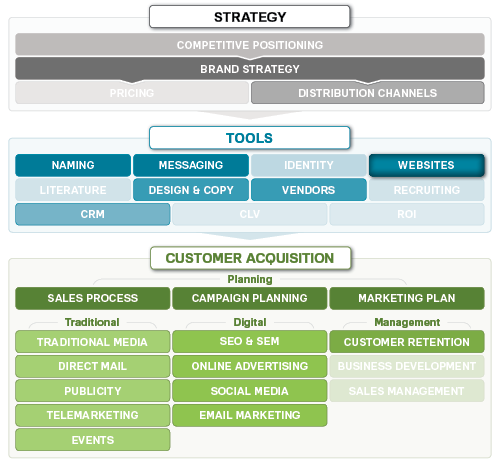
Think of your website site as an interactive brochure that speaks with different groups and converts visitors into prospects and customers. It’s an extension of your brand and an example of the quality of work you do.
Although a website design and development project can be a substantial investment, it doesn’t have to break your budget; it just needs to effectively communicate with your market and support your brand. Yet when you develop your website with rich content and some basic marketing functionality, you gain broad and potentially lucrative marketing capabilities.
| Best Case | Neutral Case | Worst Case |
|---|---|---|
| Your website is more than a brochure; it sells. You use it for a variety of internet marketing campaigns: search, email, webinars, ongoing communications, publicity and more.
Your content is relevant; you know how many leads your campaigns generate and what those leads cost. You can quickly create landing pages for campaigns so you can convert traffic into prospects. |
You have a standard website with basic information plus a few press releases & newsletters. You’ve tried some internet marketing with mixed results.
You know your prospects look at your website and it could be better, but it’s no different than your competitors. There are bigger priorities than a website redesign, but you suspect that more content & functionality would give you more marketing power. |
Your website works against you. It may be the design, content (or lack of), writing, or functionality. It doesn’t support your value proposition and you can’t do any internet marketing campaigns.
You wince when prospects ask for the URL; you know they don’t get a good impression from your site and your competitors look better and stronger. You can’t quantify whether you’ve lost any business – but you know you probably have. |
Not Sure Where to Start with Your Website Design and Development Project?
Access detailed step-by-step plans in our new marketing website.
It’s free to use
Website Design and Development Key Concepts & Steps
Before you start a new site project
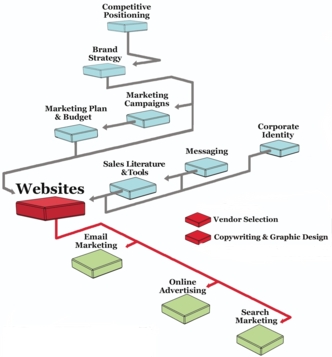
Make sure you’ve tackled your brand strategy, corporate identity, messages and sales literature before developing your website. A website project may also flow from your annual marketing plan, particularly if you’ve decided to pursue more aggressive internet marketing campaigns.
Develop your project team and timeline
- Work backward from key deadlines to create your project timeline. Give yourself plenty of leeway since website projects can easily hit snags.
- If you’re launching a sophisticated site, make sure you’ve included all of the relevant departments in your project team.
Define your website needs
Before you hire a designer or developer, decide what your site needs to accomplish:
- Your major goals
- How the website will support online and traditional marketing campaigns
- How the website will help you generate leads, nurture prospects, communicate with your market, process orders, etc.
- The information and functionality you believe you’ll need
- Whether a basic design is fine or whether you’ll need something more unique and customized
Develop your website content
- Determine a preliminary game plan for your internet marketing efforts so that your site can support them.
- List the “users” who will visit your site: new prospects, existing prospects, customers, partners, media, job applicants, vendors, etc.
- Develop a list of the information and tools (“content”) each user wants to find on your site.
- Review competitor and other industry sites for additional ideas.
Organize the content
Organize your content so users can quickly find what they need. You’ll also incorporate Search Engine Optimization (“SEO”) techniques to help with search engine rankings. For example, your home page is most important to search engines; if you don’t have rich content on that page, you won’t rank as highly.
Identify functionality you’ll need
- You may want to display product details and process orders.
- Determine whether you want to let customers access their records on the site.
- Evaluate other functionality such as search, calculators, streaming video or other capabilities.
Develop your design requirements
Like your sales literature, your site should convey your brand. Use your regular color palette, typefaces and personality traits as much as possible.
Identify any last requirements
- Requirements for updating and managing the content
- Programming technologies you do and don’t want in the site
- Reporting requirements
Qualify and hire vendors
Unless you have an in-house web development team, hire vendor(s) for design, writing and/or development. Review their past work and talk with recent clients to make sure you’re comfortable with their strategy and skills.
After Your Website Design and Development is Complete
Once you’ve finished your website, use it to communicate with your market and generate leads, especially through email marketing, online advertising and search marketing.
WEBSITE DESIGN AND DEVELOPMENT TEMPLATES / MARKETING PLANS / PROJECT MANAGEMENT
EVERYTHING YOU NEED FOR YOUR WEBSITE DESIGN AND DEVELOPMENT PROJECT