Marketing Guides
Strategic Planning
Marketing Plan and Budget
A marketing plan is a detailed roadmap that outlines your marketing strategies, tactics, costs and projected results over a period of time. Your marketing plan and budget keeps your entire team focused on specific goals – it’s a critical resource for your entire company.
Some statistics have shown that up to 85% of small- to mid-size companies operate from a budget only — without a written plan to accompany it. This explains why so many marketers are tactically focused – they’re figuring out how to spend a defined budget, instead of thinking about goals and strategies.
Writing a marketing plan is a time-consuming exercise, but it forces you to think through your strategies and relevant tactics. A good marketing plan typically includes:
- Financial goals
- Positioning strategy
- Brand strategy
- Product/service overview
- Detailed goals by product, distribution channel &/or customer segment
- Sales plan
- Major marketing campaigns
- Detailed budget
- Dates to review progress
Note: You can create a detailed marketing plan using our guided, online template in our marketing planning and management app.
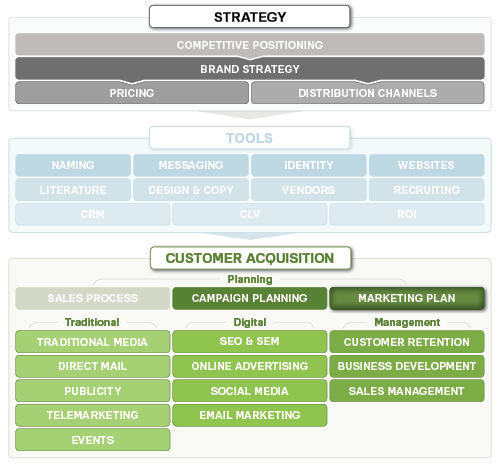
It takes time to develop a good marketing plan and budget, but it’s important because it ties all of your activities to tangible goals.
It’s also a great opportunity to focus on the future, generate new ideas, and inspire your team. Even a simple plan is better than none, but when you invest more effort upfront, you’ll have a better roadmap toward your goals.
| Best Case | Neutral Case | Worst Case |
|---|---|---|
| Your marketing plan is a detailed roadmap to meet your goals.
You recognize that the time you invest to create a solid plan is perhaps the best time you’ll invest all year – it helps you work through new strategies, issues, ideas, and numbers. When it’s done, your team focuses on executing the plan and measuring your progress all year long. As a result, you’ve been able to hit your goals, grow your business, and enjoy the journey. |
You’re incredibly busy, so it’s difficult to invest the time in a detailed marketing plan. Instead, you develop a basic plan that’s based on last year’s version.
You include general revenue goals, general sales strategies, and basic campaigns; you stick with proven techniques. Budgets are based on last year’s numbers. You could be more ambitious with your revenue goals if your company were willing to try new things, but each year you stick with the tried-and-true. |
You don’t create a marketing plan. You have a budget, but the numbers are haphazard. Things change so quickly – why spend the time?
You take a similar approach with the strategies that should drive a marketing plan. You probably don’t have a positioning or brand strategy; you’re missing out on distribution channels or partnerships; your campaigns are ineffective and you may not invest in customer retention. A plan is a compass. Without one, you may be traveling in the right direction, but it’s incredibly difficult to stay on course – and that can drastically limit your success. |
Not Sure Where to Start with Your Marketing Plan and Budget?
Access detailed step-by-step plans in our new marketing website.
It’s free to use
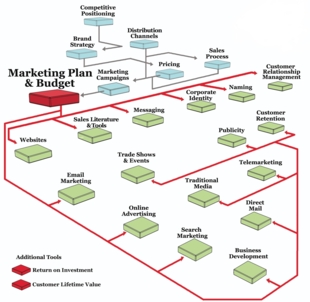
Marketing Plan and Budget Key Concepts & Steps
Before you begin
Since your plan should address your budget and all of your strategies and tactics, you’ll need to review your brand strategy, pricing strategy and distribution channels beforehand. You’ll also outline your major marketing campaigns for the year since they’ll be in your budget.
Set your annual goals
Design your plan to achieve the goals that you define:
- Quantitative (numeric) goals such as total revenue, profit, number of customers, units sold, and breakdowns by product or channel as needed.
- Strategic goals — for example, you may want to expand into a new market with a new distribution channel, or you may need to reposition your brand to reflect a change in your business.
Emphasize your positioning in the marketplace
- Your positioning strategy defines how you’ll differentiate your offering from those of your competitors.
- Your brand strategy defines what you stand for and how you’ll communicate with the market.
Outline any plans for your products & services
If you need to do anything to strengthen your product line and better support your positioning, address those issues in your plan.
Develop your tactical sales plan
- The number of sales reps you’ll need and the markets they’ll target
- Whether you’ll need to develop new compensation plans, or hire and train new personnel
- Top priority markets, industries or customer segments; if you have a list of key prospects, include them
- Your plan for managing current customers
- Plans for launching any new distribution channels and driving revenue through existing channels
Outline your major marketing campaigns
You don’t need to list every campaign — just outline your major promotional plans for the year. You’ll need to set your budget too, so the more planning you do now, the better. Your plans should include:
- The top three campaigns you’ll run to generate leads, nurture customers, close, and/or market to existing customers
- The media you’ll use (for example, email, social, print, telemarketing, trade shows, publicity, etc.)
- Tools, technologies or resources you’ll need – for example, a new website, an email service provider, or a new piece of software
- Your estimated ROI and other financial goals
Develop a marketing budget
- Budgeting can be a difficult process. Many companies just estimate, or base their budget on last year’s spend. An estimate is better than nothing, but if you’ve defined your major campaigns and needs, you can develop better numbers.
- You also use ROI to determine the appropriate total budget for your marketing efforts.
Revisit your marketing plan regularly
- The planning process itself is immensely valuable, but if you don’t review the plan regularly, it’s easy to lose focus. Periodically revisit the plan, and measure your progress.
After Creating Your Marketing Plan and Budget
When you’ve finished your plan and budget, it’s time to execute.
You may need to create new messages, literature, websites or other tools and processes for your marketing campaigns, but after that, focus on generating and managing your customers.
MARKETING PLAN AND BUDGET TEMPLATES / MARKETING PLANS / PROJECT MANAGEMENT
EVERYTHING YOU NEED FOR YOUR MARKETING PLAN PROJECT