Marketing Guides
Strategic Planning
Distribution Channels
Distribution channels in marketing are one of the classic “4 Ps” (product, promotion, price, placement a.k.a. “distribution”). They’re a key element in your entire marketing strategy — they help you expand your reach and grow revenue.
B2B and B2C companies can sell through a single distribution channel or through multiple channels that may include:
- Wholesaler/Distributor
- Direct/Internet
- Direct/Catalog
- Direct/Sales Team
- Value-Added Reseller (VAR)
- Consultant
- Dealer
- Retail
- Sales Agent/Manufacturer’s Rep
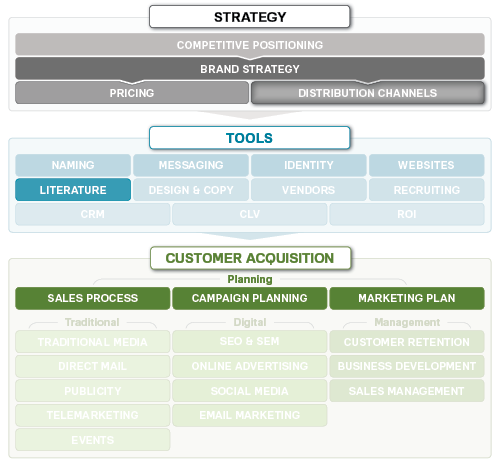
Here are three examples of distribution channels in marketing:
| DIRECT TO END USERS | SELL THROUGH A DEALER NETWORK | SELL THROUGH A VAR (VALUE-ADDED RESELLER) |
|---|---|---|
| You have a sales team that sells directly to Fortune 100 companies.
You have a second product line for small businesses. Instead of using your sales team, you sell this line directly to end-users through your website and marketing campaigns. You have two markets and two distribution channels. |
You sell a product through a geographical network of dealers who sell to end-users in their areas. The dealers may service the product as well.
Your dealers are essentially your customers, and you have a strong program to train and support them with marketing campaigns and materials. |
You sell a product to a company who bundles it with services or other products and resells it.
That company is called a Value Added Reseller (VAR) because it adds value to your product. A VAR may work with an end-user to determine the right products and configurations, and then implement a system that includes your product. |
To create a good distribution program, focus on the needs of your end-users.
- If users need personalized service, you can utilize a local dealer network or reseller program to provide that service.
- If your users prefer to buy online, you can create an e-commerce website and fulfillment system and sell direct; you can also sell to another online retailer or distributor that can offer your product on their own sites.
- You can build your own specialized sales team to prospect and close deals directly with customers.
Wholesalers, resellers, retailers, consultants and agents already have resources and relationships to quickly bring your product to market. If you sell through these groups instead of (or in addition to) selling direct, treat the entire channel as a group of customers – and they are, since they’re buying your product and reselling it. Understand their needs and deliver strong marketing programs; you’ll maximize everyone’s revenue in the process.
| Best Case | Neutral Case | Worst Case |
|---|---|---|
| You’ve used one or more distribution channels to grow your revenue and market share more quickly than you would have otherwise.
Your end-users get the information and service they need before and after the sale. If you reach your end-user through wholesalers, VARs or other channel partners, you’ve created many successful marketing programs to drive revenue through your channel and you’re committed to their success. |
You’re using one or more distribution channels with average success.
You may not have as many channel partners as you’d like, but your current system is working moderately well. You devote resources to the program, but you wonder whether you’d be better off building an alternative distribution method — one that could help you grow more aggressively than you are growing now. |
You probably aren’t hitting your revenue goals because your distribution strategy is in trouble.
With your current system, you may not be effectively reaching your end-users; your prospects probably aren’t getting the information and service they need to buy your product. Your current system may also be difficult to manage. For example, channel members may not sell at your suggested price; they don’t follow up on leads you deliver; they don’t service the product very well and you’re taking calls from angry customers. |
Not Sure Where to Start with Your Distribution Channels?
Access detailed step-by-step plans in our new marketing website.
It’s free to use
Distribution Channels Concepts & Steps
Before you begin
You can evaluate a new distribution channel or improve your channel marketing / management at any time. It’s especially important to think about distribution when you’re going after a new customer segment, releasing a new product, or looking for ways to aggressively grow your business.
Evaluate how your end-users need to buy
Your distribution strategy should deliver the information and service your prospects need. For each customer segment, consider:
- How and where they prefer to buy
- Whether they need personalized education and training
- Whether they need additional products or services to be used along with yours
- Whether your product needs to be customized or installed
- Whether your product needs to be serviced
Match end-user needs to a distribution strategy
- If your end-users need a great deal of information and service, your company can deliver it directly through a sales force. You can also build a channel of qualified resellers or consultants. The size of the market and your price will probably dictate which scenario is best.
- If the buying process is fairly straightforward, you can sell direct via a website/catalog or perhaps through a wholesale/retail structure. You may also use an inbound telemarketing group or a field sales team.
- If you need complete control over your product’s delivery and service, adding a channel probably isn’t right for you.
Identify natural partners
If you want to grow beyond the direct model, look for companies that have relationships with your end-users. If consultants, wholesalers or retailers already reach your customer base, they’re natural partners.
Build your distribution channel
If you’re setting up a distribution channel with one or more partners, treat it as a sales process:
- Approach the potential channel partner and “sell” the value of the partnership.
- Establish goals, service requirements and reporting requirements.
- Deliver inventory (if necessary) and sales/support materials.
- Train the partner.
- Run promotions and programs to support the partner and help them increase sales.
Minimize pricing conflicts
If you use multiple channels, carefully map out the price for each step in your channel and include a fair profit for each type of partner. Then compare the price that the end-user will pay; if a customer can buy from one channel at a lower price than from another, your partners will rightfully have concerns. Pricing conflict is common, and it can jeopardize your entire strategy, so do your best to map out the price at each step and develop the best solution possible.
Drive revenue through the channel
Service your channel partners as you’d service your best customers and work with them to drive revenue. For example, provide them with marketing funds or materials to promote your products; run campaigns to generate leads and forward them to your partners.
After Designing Your Distribution Channels
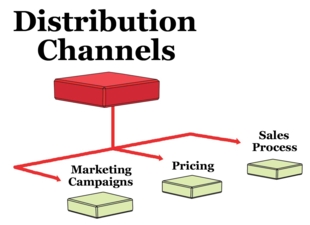
As you’re creating a new channel you’ll need a pricing strategy and a sales process. When your channel is up and running, you can start launching marketing campaigns to channel partners and end-users.
However, it’s alway best to start with defining your brand strategy. Learn more about how to build yours with our brand strategy toolkit.