Marketing Guides
Strategic Planning
Customer Retention Strategy
How much have you invested in sales and marketing over the last few years? Thousands? Tens of thousands? Millions? Tens of millions?
Your customer retention strategy is about keeping the customers you’ve invested in to acquire. And if you’re in an industry where your customers make multiple purchases over the years, your entire team should be very focused on retaining those customers:
- Delivering service that’s consistent with your value proposition and brand
- Cross-selling, up-selling and asking for referrals from existing customers
- Developing programs to increase customer loyalty and decrease turnover
- Knowing the lifetime value for different segments and using that data to improve your marketing
- Prioritizing retention as a major focus in your annual marketing plan
[Note: You can download our free customer loyalty measurement calculator that uses the RFM method by creating a preview account.]
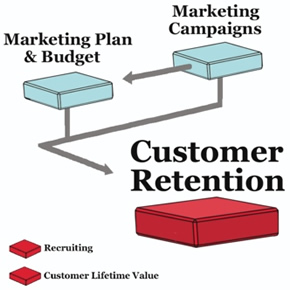
Studies show that it costs ten times more to generate a new customer than to maintain an existing one. If you have a small number of customers, losing a few could cripple your company. Even if you have a large number of customers, a small increase in your customer retention rate should dramatically increase your profits. In his book The Loyalty Effect, Fred Reichheld writes that “a 5% improvement in customer retention rates will yield between a 25 to 100% increase in profits across a wide range of industries.”
With a strong customer retention strategy, it’s much easier to grow your revenue and profitability. Do you see your company in any of these scenarios?
| Best Case | Neutral Case | Worst Case |
|---|---|---|
| Your company is focused on customer retention and it has paid off. Renewals are high; you put a lot of effort into campaigns and service for existing customers.
Sales reps are incented to keep customers happy, and you use financial modeling and surveys to identify problems and focus on vulnerable customers. Your revenue has grown substantially each year because you’re adding new customers without losing current ones. |
You know how important it is to retain customers. The reps who service existing customers are good, but you’ve lost some customers that you shouldn’t have.
You’ve sent out some surveys, but haven’t done much with the data from them. And you struggle with the commission for current business – some people argue that you shouldn’t pay at all because they’re house accounts. As a result, you have to replace numerous customers each year. |
You don’t formally market to your current customers. You know your service could be better, but you haven’t had the time to develop a strategy or improvement plan. You definitely have more turnover than you’d like.
As a result, you’re continually investing to generate new customers. Your revenue profit margins are much lower than they could be, and the churning takes its toll on your organization. |
Not Sure Where to Start with Your Customer Retention Strategy?
Access detailed step-by-step plans in our new marketing website.
It’s free to use
Customer Retention Strategy Steps
Before you begin
You can work on your customer retention strategy at any time, and marketing campaigns to them may be an important part of your strategy. You may also decide to increase your focus on retention when you’re writing your annual marketing plan. But if you’re losing customers, don’t hesitate to focus your energy on retention right now.
Determine your retention strategy
Your value proposition and brand strategy should drive your retention plan. For example, if your value proposition is customer intimacy, your customers are counting on great service. If they’re buying on price, you’ll usually focus more on automating service to minimize costs.
Build your team
In some industries, the original sales rep is the best person to manage an existing client — for example, the account may require ongoing selling. In other cases it’s better to transition the customer to an account rep who focuses on day-to-day management.
Once you’ve decided how to structure the team, determine how many people you’ll need and start recruiting.
Pay commission for renewals and growing the business
Your current customers are your most valuable asset; if your sales reps don’t earn commission on renewals, they’ll be incented to spend their time chasing new business instead.
Market to existing customers
Put as much effort into your current customer campaigns as you put into the rest of your marketing programs. Know your audience, grab their attention, focus on the offer, measure your results. Use campaigns to
- Nurture your customer relationships
- Encourage customers to buy again
- Expand your relationships by cross-selling, up-selling and asking for referrals
- Identify customers who are at risk of defecting
- Continually deliver on your value proposition and brand promise
Measure purchase intent and loyalty, not “satisfaction”
Customer feedback can help you improve your products and enhance your relationship with your customers. However, it’s not effective to measure “customer satisfaction” because it’s so vague. “Satisfied” doesn’t mean they intend to keep buying. Instead, focus on behavior: Ask whether they intend to buy again and why or why not. Ask what three things you can improve upon and whether they’ll provide referrals. These questions provide more actionable insight than “satisfaction.”
Use data to evaluate large groups of customers
If you don’t have personal relationships with your customers, use data to identify customers who haven’t purchased in the normal timeframe. They may be at risk of defecting and you can launch retention campaigns and encourage them to stay.
After Designing Your Customer Retention Strategy
Continue refining and improving your customer retention strategy and execution — it may deliver the highest marketing ROI of all your marketing programs.
1 Frederick Reichheld, The Loyalty Effect (Harvard Business School Press, 1996)
CUSTOMER RETENTION STRATEGY TEMPLATES / MARKETING PLANS / PROJECT MANAGEMENT
EVERYTHING YOU NEED FOR YOUR CUSTOMER RETENTION STRATEGY PROJECT