Marketing Guides
Strategic Planning
Brand Strategy
Your brand is more than your logo, name or slogan — it’s the entire experience your prospects and customers have with your company, product or service.
Your brand strategy defines what you stand for, a promise you make, and the personality you convey. And while it includes your logo, color palette and slogan, those are only creative elements that convey your brand. Instead, your brand lives in every day-to-day interaction you have with your market:
- The images you convey
- The messages you deliver on your website, proposals and campaigns
- The way your employees interact with customers
- A customer’s opinion of you versus your competition
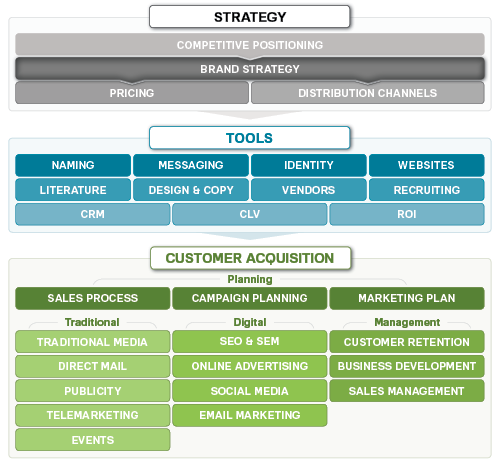
The Value of Creating a Defined Brand Strategy
Branding is crucial for products and services sold in huge consumer markets. It’s also important in B2B because it helps you stand out from your competition. Your brand strategy brings your competitive positioning to life, and works to position you as a certain “something” in the mind of your prospects and customers.
Note: Check out our brand strategy toolkit — for step-by-step guidance while designing your brand strategy.
Think about successful consumer brands like Disney, Tiffany or Starbucks. You probably know what each brand represents. Now imagine that you’re competing against one of these companies. If you want to capture significant market share, start with a strong brand strategy or you may not get far.
In your industry, there may or may not be a strong B2B brand. But when you put two companies up against each other, the one that represents something valuable will have an easier time reaching, engaging, closing and retaining customers.
Successful branding also creates “brand equity” – the amount of money that customers are willing to pay just because it’s your brand. In addition to generating revenue, brand equity makes your company itself more valuable over the long term.
Does your company follow a defined strategy for your brand? Which case do you fall under?
| Best Case | Neutral Case | Worst Case |
|---|---|---|
| Prospects and customers know exactly what you deliver. It’s easy to begin dialogue with new prospects because they quickly understand what you stand for.
You acquire customers quickly because your prospects’ experience with you supports everything you say. You can charge a premium because your market knows why you’re better and is willing to pay for it. |
The market may not have a consistent view or impression of your product and company, but in general, you think it’s positive.
You haven’t thought a lot about branding because it doesn’t necessarily seem relevant, but you admit that you can do a better job of communicating consistently with the market. You’re not helping yourself but you’re not hurting yourself either. |
You don’t have a brand strategy and it shows. It’s more difficult to communicate with prospects and convince them to buy.
They don’t have an impression of your product/service or why it’s better. What you do, what you say and how you say it may contradict each other and confuse your prospects. Competitors typically have an easier time acquiring customers. |
Looking for More Brand Strategy Guidance?
Access detailed step-by-step plans in our new marketing website.
It’s free to use
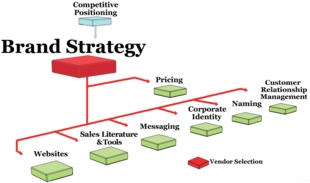
Brand Strategy Key Concepts & Steps
Before you begin
Before working on your brand strategy, make sure you’ve identified your competitive positioning strategy – your brand strategy will bring it to life.
If you have a brand strategy, make sure it’s as effective as possible
- Poll your customers, employees and vendors by conducting a brand audit. Are their impressions consistent with your strategy? If not, work on the elements you can improve.
Develop your brand around emotional benefits
- List the features and benefits of your product / service. A feature is an attribute – a color, a configuration; a benefit is what that feature does for the customer.
- Determine which benefits are most important to each of your customer segments.
- Identify which benefits are emotional – the most powerful brand strategies tap into emotions, even among business buyers.
- Look at the emotional benefits and boil them down to one thing that your customers should think of when they think of you. That’s what your brand should represent.
Define your brand personality, story and positioning statements
- Think of your brand as a person with a distinct personality. Describe him or her, then convey these brand personality traits in everything you do and create.
- Write positioning statements and a story about your brand; use this brand messaging throughout your company materials.
- Choose colors, fonts and other visual elements that match your personality and create your corporate identity.
- Determine how your employees will interact with prospects and customers to convey the personality and make sure your brand “lives” within your company.
After Brand Strategy
Together with your competitive positioning strategy, your brand strategy is the essence of what you represent. A great brand strategy helps you communicate more effectively with your market, so follow it in every interaction you have with your prospects and customers.
If you’re wondering how to choose a great brand name, complete your written brand strategy before you start the naming process. Since your name is an extension of your brand, it’ll be much easier to evaluate the quality of your name choices (instead of starting with the name) with it completed.
Check out our comprehensive brand strategy planning tools if you’d like guidance.